

We have already talked about many of Africa’s characteristic animals that can be encountered on a Tanzania tour, such as Masai lions and cudus, peculiar antelopes, but we are missing one of the most beautiful animals of the Savannah: the Cheetah, the world’s fastest and most elegant feline.
The Cheetah, Acinonyx jubatus, is the world’s fastest carnivore, and belongs to the felid family, the same as lions, leopards, tigers and jaguars. Despite this, it has many characteristics different from the feline species, more similar to those of canids, such as long hoes and only partly retractable claws.
If you want to find out in detail about this beautiful animal, all you have to do is continue reading.
Etymology of the Name
”
” The etymology of the names—both the Greek and the Italian—is quite complex. The Greek term “Acinonyx ” is derived from the combination of two Greek words meaning “claw ” and “immobile,” specifically to indicate its distinctive characteristic of having non-retractable claws, unlike all other felines. “Jubatus, ” on the other hand, is a Latin term meaning “maned, ” referring to the presence of thicker fur around the neck.
The name Ghepardo became part of the Italian language only fairly recently, namely in 1874, and is said to derive from the French term guépard , which may in turn derive from the Italian gattopardo, a word used to refer to spotted felines.
State of conservation
Today, this magnificent feline is at risk of extinction and is a vulnerable species, threatened primarily by population pressure. For example, in the 1960s, the number of cheetahs in Serengeti National Park was estimated to be around 250. Today, however, according to the most recent data, only 40-50 remain.
More than any other feline, the cheetah needs a vast grassy savannah around it as its living space. Only in such a habitat, thanks to its highly specialized hunting technique , which makes it the fastest mammal on earth, can it find and capture its prey. To construct an ideal hunting ground for the cheetah, the savannah must have a simple requirement: grass that is not too low to cover its movements as it approaches its prey, but also not so high that it hinders the shot that enables it to capture it.
Cheetah Dimensions
Cheetahs measure approximately 120–150 cm in length, plus a tail measuring 70–80 cm. Their height at the withers, on the other hand, is 70–90 cm. However, this feline is particularly slender and lean—a key factor in enabling its tremendous acceleration—and in fact rarely exceeds 60 kg.
Maximum Speed of Cheetahs
The cheetah is known to be the fastest mammal in the world and the one with the greatest acceleration, but tests have been conducted that have redefined its maximum achievable speed. In fact, until the 2000s, measurements taken around the 1950s were accepted as accurate, according to which the animal’s top speed was around 110–120 km/h.
However, in 2013, further verifications and measurements were carried out using much more sophisticated technologies and instruments, thanks to which it was possible to verify that the maximum speed of cheetahs is 93 km/h.
Lion, Leopard, and Cheetah: A Rivalry on the Hunting Grounds
Although leopards, lions, and cheetahs share the same habitat and often prey on the same animals, their hunting styles differ significantly:
the leopard assaults its prey by surprise, many times jumping on its back from a tree. In contrast, lions are capable of sprinting , and reach even for short distances up to 80 kilometers per hour. In fact, they need not run faster because that is the speed of their prey: zebras antelopes and gazelles.
Since the African lion, in running, does not even remotely have the stamina of his victims, he is forced to get as close to them as possible before sprinting briefly to assault his prey, trusting in the instant of terror that will paralyze it. The cheetah, on the other hand, because of its speed record, can afford to be spotted by its prey because it knows it can catch up with its chosen victim.
And this, perhaps, is why the cheetah is the only feline that hunts during the day. This difference in hunting schedules with its rivals often allows it to avoid the danger of being in turn plundered of its loot by its competitors: lions, leopards, hyenas. If one of these animals encounters a cheetah that has just captured its prey, the cheetah leaves the field without giving battle. It has no fighting spirit.
And so, about 12 percent of its prey ends up in someone else’s stomach. Naturalist George B. Schaller studied not only the behavior of lions but also that of cheetahs in the Serengeti; and a second monograph was written by zoologist Roland McLaughlin, who spent years studying the cheetah population in Nairobi National Park.
Adult cheetahs that hunt in groups are an exception
Usually, when a cheetah hunts alone—which is the case most of the time—it always chooses prey smaller than itself. In the Serengeti, these are almost always Thomson’s gazelles. In Nairobi National Park, they often include impalas, Grant’s gazelles, and small wildebeests. However, in both areas, more than half of the prey consists of young animals.
Evidently , the cheetah knows who it can reach the easiest and is content with a few fewer grams of food. Also according to specialists’ statistics, in 26 consecutive days a female cheetah, mother of two cubs, kills more than about 20 Thomson’s gazelles and one rabbit.
From this we infer that females with offspring catch about one prey per day. Solitary specimens, on the other hand, hunt every two or three days. Adult cheetahs rarely hunt together. One exception was a group of four male cheetahs, which had probably made friends in Nairobi National Park.
Their chances of success were clearly greater than those of solitary hunters, so much so that they also attacked and killed adult buffalo and zebra; prey, in this case, larger than themselves. In general, however, cheetahs are rather solitary. If two adults meet, they change direction and watch each other until one disappears from the sight of the other. Cheetahs do not defend a territory of their own.
Each certainly has its own zone of action, but it may well encroach on that of another cheetah without a fight ensuing. Indeed, in the Serengeti, constant exchanges of territory take place. But it is not the cheetahs that change zones, but Thomson’s gazelles, which continually migrate throughout the year pursued by the felines.
Cheetah Mating and Breeding
Males and females mark their territory with urine; the purpose is clear: it serves as a call for mating. It is only at this moment that most cheetahs set aside their deep-rooted indifference toward their own kind. In any case, the union is very short-lived, and immediately after mating, each goes its separate way.
Until recently, unlike with other felines, it had not been possible to breed cheetahs in captivity. Until 1967, known cases of cheetah births in zoos around the world amounted to only 8. Today it is certain that the group life they are forced to endure in captivity is to blame.
In fact, they are usually kept in pairs, and given their solitary nature, this is undoubtedly a mistake. George B. Schaller believes that females need a male from outside the group to become aroused and desire mating. He cites the example of a private zoo in Italy where exceptional breeding results were achieved: as soon as a female went into heat, a male was brought in from a nearby zoo. Since that first experiment, cheetah breeding has been well established. At the San Diego Zoo in the United States alone, 32 cheetah cubs have been born and raised.
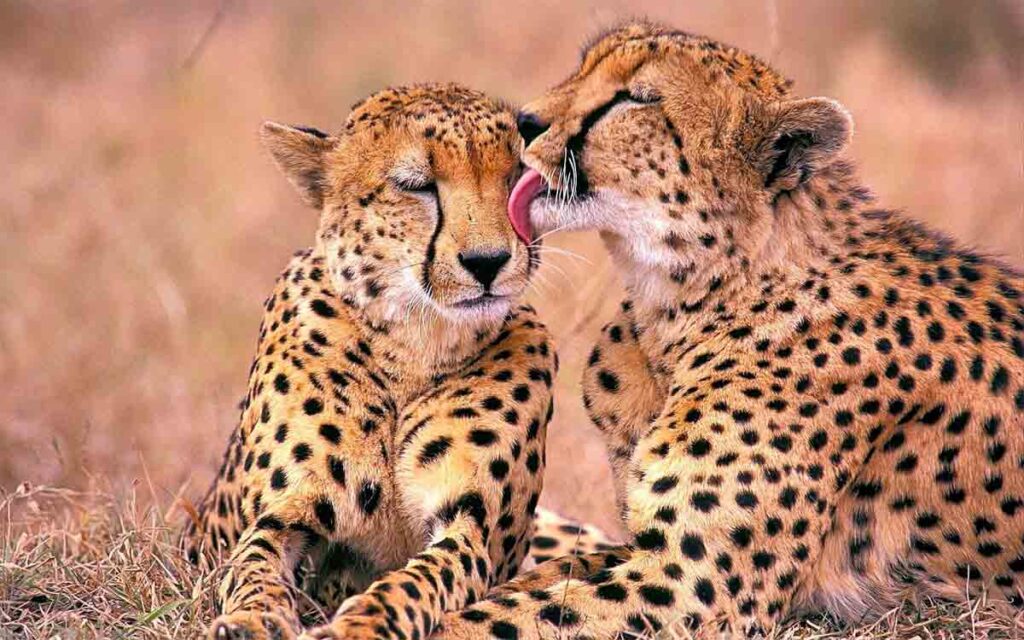
After ninety-five days of gestation the female cheetah gives birth to three or four cubs. In the first three months of life the cubs are smoky gray with indefinable color maculation and a soft blue-gray mane extends from the forehead across the back. In the first six weeks of life, baby cheetahs usually remain hidden in dense bushes.
Then they begin to follow their mother more and more often, even in open terrain. It’s a dangerous adventure: hyenas, leopards, lions, and even some large birds of prey pose a constant threat. It is estimated that in the first six weeks of life, about half of the cheetah cubs die from disease or are killed by other predators.
Those who manage to survive this dangerous period are instructed by their mother in the art of hunting. If until then the cheetah cubs had only observed how the mother behaved during the hunt, from the third month onward things change: the mother brings her offspring some small gazelle still alive.
But the youngsters’ attempts on that easy prey remain unsuccessful for the long run; it will have to take about a year for the young cheetah to be able to kill on its own.
At this point, the bond between mother and cub is broken, and each goes its separate way. In most of its original Asian habitats, the cheetah has been exterminated. A small number of cheetahs still live in the mountainous regions of northern Iran and probably also in the neighboring Soviet republic of Turkmenistan.
The Last Cheetahs
The Persian government even established a cheetah reserve. All of Black Africa, with the exception of the tropical forests and the central Sahara, was once home to cheetahs. In North Africa, their numbers were reduced to zero without any discernible pattern (in 1968, a driver hit a cheetah in Tunisia, but this was certainly an isolated incident: perhaps a cheetah that had escaped from its owner). The swift, long-legged feline survives only south of the Sahara.
Across Africa, their population appears to fluctuate between 3,000 and 10,000 individuals. This is an extremely low number, and even more catastrophic is the fact that the export of their skins—whether legal or not—continues at a steady pace. In 1968, 1,283 cheetah skins were legally imported into the United States, and in 1969, as many as 1,885.
The new international conventions for the protection of endangered wild animal species are a first step toward safeguarding these felines. However, national parks cannot guarantee their safety because they are unable to provide the necessary protection against poachers, who are increasingly engaged in illegal hunting.
Killing a cheetah—an animal that doesn’t hide, doesn’t try to escape, and doesn’t attack humans—is certainly not difficult, and can, unfortunately, be very lucrative.