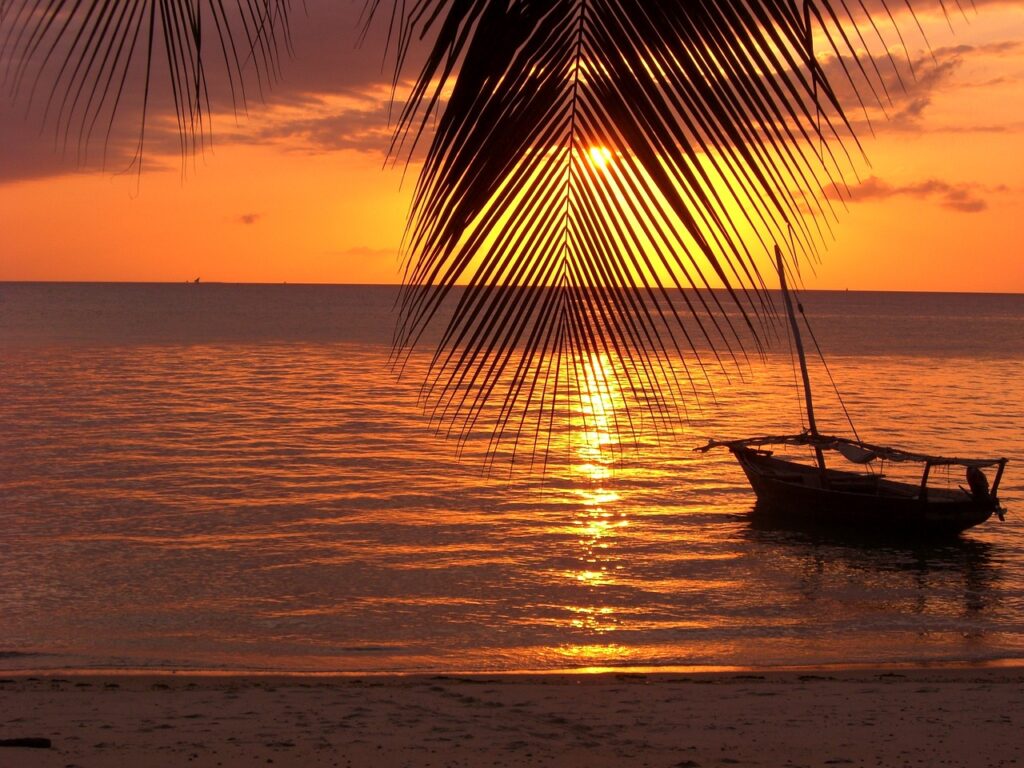


Jambiani is a cluster of small villages stretching along about 6 kilometers of beach on the southeastern coast of Unguja, the main islandof the Zanzibar archipelago. It is one of the quietest spots on the island: no large hotel complexes, just fishermen returning in their dhows, women harvesting seaweed and sponges in the lagoon, and a tide that completely transforms the landscape twice a day.

It’s the perfect destination for those who, after a safari in Tanzania, are looking for a few days of laid-back beach life and authentic contact with local life. It’s less suitable for those seeking nightlife or a beach where they can swim at any time of day: as we’ll see, the tides rule here.
Tides: What You Need to Know
In Jambiani, as along the entire eastern coast of Zanzibar, the tidal range is very wide. At low tide, the ocean recedes hundreds of meters, exposing a vast expanse of sand, pools, and seaweed beds; at high tide, the sea returns all the way to the beach. In short:
- swimming is best only at high tide: at low tide, the water is too shallow;
- low tide is the best time to walk along the seabed, observe starfish and small fish in the pools, and watch the work being done in the seaweed farms;
- there are sea urchins and sharp corals on the seabed: rock-pooling shoes are recommended;
- the times change every day: it’s best to ask the facility for the tide table and plan your day accordingly.
The Women of the Sea: Seaweed and Sponges

Algae cultivation
At low tide, rows of stakes and ropes holding seaweed can be seen along the lagoon: along with fishing, seaweed cultivation is one of the village’s main sources of income and is almost entirely women’s work. Women reach the fields on foot, carrying colorful kanga and buckets, and spend hours in the water planting, cleaning, and harvesting. The seaweed is then dried in the sun and mostly exported. In Paje, the neighboring village, a cooperative transforms it into soaps and cosmetics scented with the island’s spices, and it is open to visitors.
The cultivation of sponges
In recent years, a natural sea sponge farm has also emerged in Jambiani, initiated through a project with the University of Zanzibar’s Institute of Marine Sciences. The sponges are more resistant to sea warming than algae and provide the women involved, many of whom are single, with a more stable income. After a year of training, each manages their own small farm. The sponges can be purchased directly: they make a useful memento and are more profitable for the producers than any other souvenir.
Snorkeling on the reef from a dhow

Off the coast of Jambiani lies the coral reef, which you can reach aboard dhows—traditional sailing boats—alongside the village fishermen. You set out when the tide allows, and in just a few minutes you arrive at spots where the water is crystal-clear, among corals, tropical fish, and starfish. You don’t need to be an expert swimmer, but it’s a good idea to ask for a mask and a life jacket and to make sure the boat has the necessary safety equipment on board. Trips are arranged directly on the beach or through your accommodation for just a few dollars per person.
For those looking for more, Jambiani has dive centers offering scuba diving trips, and boat tours to spot dolphins depart from Kizimkazi, at the southern tip of the island.
What to See in the Area
Kuumbi Caves
Just inland from Jambiani lie the Kuumbi Caves, limestone caverns considered sacred by the local community and also significant for the island’s archaeology. They can be visited with a guide or as part of an organized tour.
The Muyuni Forest and Jozani Park
Behind the southeastern coast lies the Muyuni Forest Reserve, an area of coastal forest recognized as a key biodiversity hotspot and the focus of conservation projects involving nearby village communities. To get a close-up view of the Zanzibar red colobus, the island’s endemic monkey, the best place to go is Jozani-Chwaka Bay National Park, accessible by car from Jambiani, with boardwalks through the mangroves and guided trails.
Paje and the coast to the north
A few kilometers to the north lies Paje, a livelier town known for kitesurfing and its beach bars. At low tide, you can walk along the coast through Paje, Bwejuu, and Dongwe—one of the island’s most beautiful walks.
Practical Information
- How to get there: From Zanzibar Airport or Stone Town, it takes about an hour by car, either via a private transfer or by taxi.
- When to go: The best times to visit are from June through October and from December through February; April and May are the rainiest months. For a month-by-month breakdown, see the guide on the best time to visit Zanzibar.
- Documents and Insurance: To enter Zanzibar and mainland Tanzania, you’ll need a visa as well as mandatory health insurance. You can find all the details in the guide to visas for Tanzania and Zanzibar.
- Respect for the local community: Jambiani is a predominantly Muslim village. Away from the beach, it’s best to wear clothing that covers your shoulders and knees, and it’s good practice to always ask permission before photographing people, especially women working in the fields.
Jambiani in our travels
Jambiani pairs well with a safari in the northern parks: after days off-roading, the southeast coast offers the starkest contrast, with its slow pace and uncrowded beaches. In our Tanzania and Zanzibar packages, such as Savannah and Ocean (7 days safari and 5 days beach) or Blue Horizon , we can also organize a beach stay here. Those who prefer even more secluded islands can look into Pemba or Mafia .
For a quote or if you have any questions, please email us or call us at +39 380 253 1425. Our email address is info@safariavventura.com.